
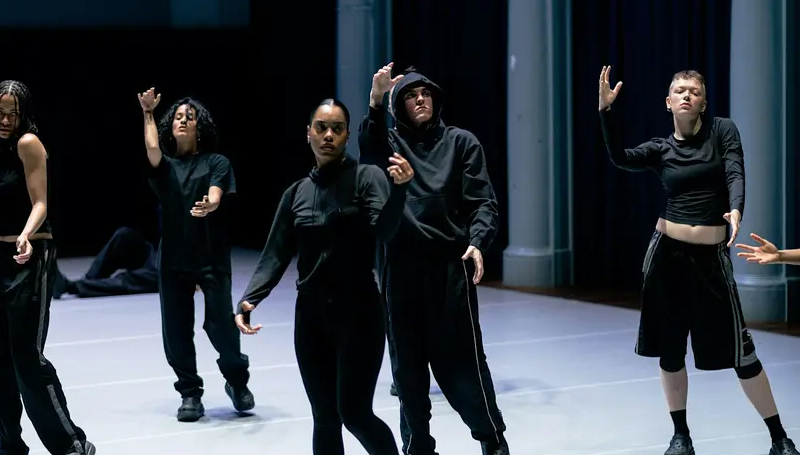
Dansvoorstellingen waarin Zuppini de perceptie en collectieve ervaring van het nachtelijke leven onderzoekt.
//ENGLISH BELOW//
Disambiguation is een hedendaagse dansproductie die de perceptie en collectieve ervaring van het nachtelijke leven onderzoekt.
Disambiguation peilt naar de libidinale drijfveer en zintuiglijke overprikkeling van het nachtelijke leven in zijn raadselachtige, duistere dimensies.
Elisa Zuppini choreografeert een systeem waarin menselijke perceptie samenkomt met anders-dan-menselijke krachten. Vijftien dansers vormen een pulserende structuur die zich uitstrekt naar het perceptuele veld van het publiek en zich daar weer uit terugtrekt. Als chtonische golven brengen zij een hybride circuit van gewaarwording voort.
Binnen het slapeloze kader van het post-clubbing verkennen de dansers de effecten en nawerkingen van het hedonistische nachtleven. Ze bewegen vanuit een dissociatieve staat van depersonalisatie, waardoor ze zich kunnen putten uit iets anders dan een geconditioneerde subjectiviteit.
Door zich te begeven in liminale en viskeuze ruimtes onderzoeken de dansers verschillende vormen van sensibiliteit. Ze navigeren door de toestand van de metadrempel — een voortdurende overgang waarin grenzen vervagen, transformatie plaatsvindt en ambiguïteit zelf tastbare toestanden vormgeeft.
Begeleid door gedeconstrueerde melodieën en industriële ritmes ontvouwt zich een beklemmende, gotische tendens. Terwijl de dansers navigeren door een wereld die op grillige wijze probeert zichzelf te begrijpen, reflecteert Disambiguation op collectieve handelingskracht en op de manier waarop gedistribueerde cognitie aanleiding geeft tot een dramaturgie van affect.
concept en choreografie Elisa Zuppini
creatie in samenwerking met de performers Hannah Badura, Rowan van den Boomen, Tara Brügger, Lola Dupriez, Mandisa Gramelsberger, Katrina Gusca, Jieon Ko, Edward Lloyd, Maxine van Lishoet, Clémence Masakidi, Esteban Alejandro Obregon Moriano, Efua-Maria Raknerud Aikins, Jentel Schiettekatte, Envel Serazin, Ditte Toppet
geluidscompositie Fabian Reichle, met originele tracks van Lotic en BFRND
dramaturgie Bruno Listopad
kostuums Elisa Zuppini en Bruno Listopad
lichtontwerp Martijn Smolders
techniek Pablo Fontdevila
productie Michael Scerbo
ontwikkeld met financiële steun van AFK (Amsterdams Fonds voor de Kunst)
coproductie van Expanded Contemporary Dance en WhyNot Festival
onderzoeks- en presentatieplatforms Amsterdamse Hogeschool voor de Kunsten (juni 2024); FLAM Festival in samenwerking met Museumnacht (november 2024, Amsterdam); Jakoozi (mei 2025, Amsterdam).
De eerste ontwikkelingsfase van dit werk vond plaats bij Expanded Contemporary Dance, onderdeel van de Amsterdamse Hogeschool voor de Kunsten, in mei en juni 2024, samen met de volgende performers uit de oorspronkelijke cast: Harvey Burke-Hamilton, Kofi Boanyah, Federica Lovato, Mia Malencia, Bo Nijssen, May van Leeuwen, Maren Weertman, Hope Landu.
//ENGLISH//
Disambiguation is a contemporary dance production that explores the perception and collective experience of the nocturnal life.
Disambiguation probes the libidinal drive and sensorial overload of nocturnal life in its enigmatic, shadowed dimensions.
Elisa Zuppini choreographs a system in which human perception converges with other-than-human agencies. Fifteen dancers form a pulsing structure, extending toward and withdrawing from the audience’s perceptual field. Like chthonic waves, they generate a hybrid circuit of sensation.
Within the insomniac framework of post-clubbing, the dancers explore the effects and aftereffects of hedonistic nightlife. They perform through a dissociative state of depersonalization, allowing them to resource from something other than conditioned subjectivity.
By inhabiting liminal and viscous spaces, the dancers explore multiple sensibilities, navigating the condition of metathreshold—a ceaseless transition in which boundaries dissolve, transformation occurs, and ambiguity itself sculpts tangible states.
Accompanied by deconstructed melodies and industrial rhythms, a haunting gothic tendency emerges. Navigating a world erratically attempting to understand itself, Disambiguation reflects on collective agency and on how distributed cognition gives rise to a dramaturgy of affect.
concept and choreography Elisa Zuppini
creation in collaboration with the performers Hannah Badura, Rowan van den Boomen, Tara Brügger, Lola Dupriez, Mandisa Gramelsberger, Katrina Gusca, Jieon Ko, Edward Lloyd, Maxine van Lishoet, Clémence Masakidi, Esteban Alejandro Obregon Moriano, Efua-Maria Raknerud Aikins, Jentel Schiettekatte, Envel Serazin, Ditte Toppet
sound composition Fabian Reichle, featuring original tracks by Lotic and BFRND
dramaturgy Bruno Listopad
costumes Elisa Zuppini and Bruno Listopad
lighting design Martijn Smolders
technic Pablo Fontdevila
production Michael Scerbo
developed with the financial support of AFK (Amsterdam Funds for the Arts)
co-produced by Expanded Contemporary Dance and WhyNot Festival
research presentation platforms Amsterdam University of the Arts (June 2024); FLAM Festival with Museumnacht (November 2024, Amsterdam), Jakoozi (May 2025, Amsterdam).
The first development phase of this work took place at Expanded Contemporary Dance, Amsterdam University of the Arts, in May and June 2024, together with more performers from the original cast: Harvey Burke-Hamilton, Kofi Boanyah, Federica Lovato, Mia Malencia, Bo Nijssen, May van Leeuwen, Maren Weertman, Hope Landu.